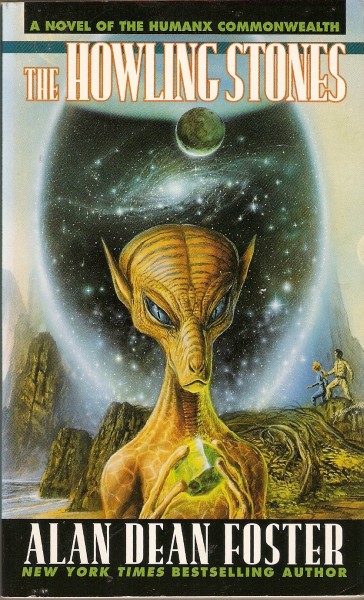
I plan on writing a review a week. But I can't stand to see the blog so barren right now. So here is a review of the book I ended up reading instead of The Watch. It's called The Howling Stones by Alan Dean Foster.
Being a writer often does not pay well. So to make full living writing often requires an author to keep publishing a steady stream of books. The daily grind of the regular author has actually been somewhat romanticized in our culture. For example, consider The Beatles 'Paperback Writer' and Kurt Vonnegut's famous character Kilgore Trout. The point is there are some books that someone has obviously pored their heart and soul into. And there are books that were written because a man must eat. The Howling Stones is the latter. It isn't a bad book by any means but it is... workman-like. It is set in Foster's continuous galactic setting of the Humanx Commonwealth. I've never read any Humanx books but this novel is entirely standalone.
The cover is oddly entirely literal. The book is about weird aliens who use glowing green stones to open oval portals to other galaxies. Heck the two main characters are even on the cover in the background about to explore the portal. The jacket blurb actually describes the entire plot basically straight up to the end. It is an incredibly straight forward book. There are primitive aliens on a tropical planet whose world is slowly being allied to one of two galactic empires the Humanx and the AAn. One island group in particular is stalling and being uncommonly stubborn. They aren't interested in awesome space technology. They are fully committed to their complex culture and are avoid anything that could erode their culture like video games. The hilariously named protagonist Pulickel Tomochelor is a low level diplomat sent in to help sway them. It turns out the aliens aren't interested in Humanx culture because they possess stones that, among other things, can open portals to other universes. Pulickel must decide what to do- seizing the stones by force is horrible but they are too powerful to not reverse engineer.
Pulickel is an interesting character and I like that Alan Dean Foster decided to write a type of charcter who has basically never been a sci-fi hero: the mid-level bureaucrat. Pulickel is devoted to his career, officious, and entirely business. He is nicely contrasted by his fellow xeno-biologist on the island Fawn Seaworth. Fawn is a statuesque blonde who is as laid back as Pulickel is by the book. There isn't much chemistry between them but then there isn't much chemistry in anything in this book.
Which is the problem of course. While I'm delighted of the novelty of Pulickel he doesn't exactly jump off the page. Nor does Fawn. Or the aliens. Foster details the alien worlds flore and fauna but personally I just couldn't find them very compelling. The writing isn't bad per se. It simply doesn't excite. Only when hopping madly between universes does the book show real life. The book ends oddly too. It just sort of stops, leaving quite a few questions and basically every plot thread loose.
The Howling Stones is a pleasant enough read. But don't expect too much from it's solid prose. I'm trying to come up with a fun rating system. Something sci-fi themed like... stars. Brilliant. Why hasn't anyone ever thought of this before?!
3 out of 7 stars!
Showing posts with label science fiction. Show all posts
Tuesday, May 10, 2011
Monday, May 9, 2011
The Watch
Lets kick this thing off. Each week I read a science fiction book. Then I give my opinion on the work. Simple as that. There is a lot of science fiction out there- my goal here is simply to act as a guide. I like to think that I have fairly solid judgement. But bear in mind that human beings tend to have differences, don't expect my review to mirror your own thoughts. If I write something egregious I'm fine with a lively rebuttal but let us keep it civil, eh?
Which is a good segue into my first review: The Watch by Dennis Danvers. This is a book that I couldn't stand but I'm sure for some they would have no problem with it. The story of The Watch is thus- Peter Kropotkin is dying of old age in 1920 after a successful seventy year career of anarchy. Then he is given a reconstructed body of himself circa age 30 and dropped in 1999 Richmond, Virginia. At which point the book deals with Peter getting a job, finding a place to live, and meeting friendly poor people. At some point the book becomes about Peter slowly unraveling the mysterious timetravelly conspiracy of his manipulative benefactor.
But I didn't get that far.
This is the only book in recent memory that I didn't bother to finish. In fact I only got 85 pages in. The rest I skimmed random pages and the ending. I want to stress that this is not normal for me, nor will it be regular for me to review books with only a portion actually read. But eighty pages in I just couldn't go on. So I write this review as a warning. The Watch has an awesome cover (I know, I know, judging book by cover etc.); it's story sounds like it has potential. But I found this dire enough to drop, something I only do very rarely. So what happened?
The short answer is I didn't like the main character. The long answer is... Peter Kropotkin is Dennis Danvers. In spirit anyways. It is clear that the third person omniscient narrator considers Peter a genius and incredibly wise. All the young punks approve of him. The homeless like the cut of his jib. Sexy not-for-profit administrators think he's remarkable. And Peter's 1920s, anarchy tinted views cut quick the ills and injustices of 1999. Or rather they would if Dennis Danvers had anything even vaguely insightful to say about modern life. In fact, Peter seems to spend more time marveling over how kick-ass airplane vodka and instant coffee are. The biting social commentary is resigned to some one-off facile thought about ravenous capitalism. By the ending Peter and his counter culture friends are supposed to be revolting against the Man or something but none of them seem to have real problems with society. They are supposed to be rebels but mostly they seem to spend their time having lunch.
All of which grew more and more annoying as it went on. The Watch purports itself to be 'a masterful novel of truly audicious conception.'* Well it tries to walk the walk but goddam if it is incapable of talking the talk. There is nothing new here but the prose puts such emphasis on itself as being, well, anarchic. It becomes intolerable to read. It's the Coffee and Cigarettes of books. So busy preening over itself it neglects to have a plot and characters worth having. If there is one thing I cannot abide it is baseless smug pretension.
It's ironic really. Peter is obviously meant to be a stand in for the author. But the constantly smirking, clumsily manipulative, and ultimately self-satisfied time travelling antagonist (Anchee) is a much better fit for the author.
*From the author's bio. Also: Yikes
Which is a good segue into my first review: The Watch by Dennis Danvers. This is a book that I couldn't stand but I'm sure for some they would have no problem with it. The story of The Watch is thus- Peter Kropotkin is dying of old age in 1920 after a successful seventy year career of anarchy. Then he is given a reconstructed body of himself circa age 30 and dropped in 1999 Richmond, Virginia. At which point the book deals with Peter getting a job, finding a place to live, and meeting friendly poor people. At some point the book becomes about Peter slowly unraveling the mysterious timetravelly conspiracy of his manipulative benefactor.
But I didn't get that far.
This is the only book in recent memory that I didn't bother to finish. In fact I only got 85 pages in. The rest I skimmed random pages and the ending. I want to stress that this is not normal for me, nor will it be regular for me to review books with only a portion actually read. But eighty pages in I just couldn't go on. So I write this review as a warning. The Watch has an awesome cover (I know, I know, judging book by cover etc.); it's story sounds like it has potential. But I found this dire enough to drop, something I only do very rarely. So what happened?
The short answer is I didn't like the main character. The long answer is... Peter Kropotkin is Dennis Danvers. In spirit anyways. It is clear that the third person omniscient narrator considers Peter a genius and incredibly wise. All the young punks approve of him. The homeless like the cut of his jib. Sexy not-for-profit administrators think he's remarkable. And Peter's 1920s, anarchy tinted views cut quick the ills and injustices of 1999. Or rather they would if Dennis Danvers had anything even vaguely insightful to say about modern life. In fact, Peter seems to spend more time marveling over how kick-ass airplane vodka and instant coffee are. The biting social commentary is resigned to some one-off facile thought about ravenous capitalism. By the ending Peter and his counter culture friends are supposed to be revolting against the Man or something but none of them seem to have real problems with society. They are supposed to be rebels but mostly they seem to spend their time having lunch.
All of which grew more and more annoying as it went on. The Watch purports itself to be 'a masterful novel of truly audicious conception.'* Well it tries to walk the walk but goddam if it is incapable of talking the talk. There is nothing new here but the prose puts such emphasis on itself as being, well, anarchic. It becomes intolerable to read. It's the Coffee and Cigarettes of books. So busy preening over itself it neglects to have a plot and characters worth having. If there is one thing I cannot abide it is baseless smug pretension.
It's ironic really. Peter is obviously meant to be a stand in for the author. But the constantly smirking, clumsily manipulative, and ultimately self-satisfied time travelling antagonist (Anchee) is a much better fit for the author.
*From the author's bio. Also: Yikes
Subscribe to:
Posts (Atom)