Wednesday, June 26, 2013

Oh Pure and Radiant Heart

*IMPORTANT: IF YOU ARE MY IN-LAWS, YOUR BOOK REVIEW IS BELOW THIS*

The title of Lydia Millet's Oh Pure and Radiant Heart should tip prospective readers off. There is a pat lyricism to the title while at the same time it mocks the atomic explosion gracing the cover. Oh Pure and Radiant Heart purports itself to be a quiet contemplative beauty while in content it more resembles a bitter 80-year old woman, screaming at the kids to get off her lawn. The sad fact is, there are many problems with Oh Pure and Radiant Heart and not much to recommend to it. So lets get into it, shall we?


The story follows Ann, a depressed hollow-eyed librarian. Ann, like the author, hates life and shambles through her existence like a zombie. Three of the leading physicists from the Manhattan Project turn up one day for no reason. These three are easily the best part of the book: each is an interesting and well rounded character. They (after endless scenes of eating out) decide that they will use their apparent second existence to press for nuclear disarmament, a noble, if fairly irrelevant goal.* Ann, like all members of the undead, crave life and latch on to the only exciting people in the entirety of Oh Pure and Radiant Heart (OPRH). They race around in increasingly boring and disjointed fashion until a flat ending.

The book that OPRH most closely resembles is The Watch. OPRH is much better written of course, and actually has several interesting characters. But the whole historical-figure-inexplicable-recreated-in-the-modern-day thing is there, and they share the same goal of serving as platforms for their respective authors' facile liberal elitism. I'm a pretty liberal dude, and I have nothing against social commentary, but Millet's grudge against the modern day seems limited to nebulous complaints about people these days being crass, not caring enough about issues, something something, whine whine. The majority of her direct examples of society's breakdown seem to boil down to the fact that poor people are gross, and stuff made for poor people is ugly.

That nastiness is really what is at the core of OPRH, once you've stripped away the flowery words. The author hates people. Poor people, rich people, hippies (which is weird since who cares about hippies anymore?), Evangelicals- Millet hates them all. She hates any location on earth that does not contain breathtaking beauty.  She has turned her back on the world and then writes a book full of ennui.

OPRH is full of poetic images. Longing suffuse the book. But the ugliness of the characters and the setting consistently undermine the prose. There is a larger problem with the style though. It follows a strict formula, and never breaks from it. The effect over time is maddening. Every. single. passage. must end in some poignant pungent statement. IE, Thirty thousand dogs are killed each year.
...
A dog, in the throes of joy, may bite a dick.
...
A dick can just as easily wound as it can be wounded.
...
Don't be a dick.
...
Et cetera, etc.

Nom nom nom

You may have gotten the sense over the course of this review that I did not enjoy Oh Pure and Radiant Heart. You would be correct in that assumption. Um, don't read this book. 0 out of 3 dead physicists awarded.

-----------------------------------------------------------

Special review for my parents-in-law

Oh Pure and Radiant Heart is a beautiful book, full of deep feeling and powerful thought. Lydia Millet has gazed into the soul (or lack there of!) of modern society and artfully illuminated it's ills. It is a deep book, funny and somber at equal turns. Two thumbs up!


*While the nuclear disarmament of unstable extremist countries is very relevant to the modern day, the disarmament of the US doesn't seem like a priority. There is about a 0% chance the US will ever use the bomb again. Too much bad PR.

Tuesday, June 25, 2013

The Handmaid's Tale

A crass but honest way of describing Margaret Atwood's The Handmaid's Tale would be to say it is 1984 for women. While I don't like to think of books being FOR only one specific gender, I cannot ignore my own discomfort when reading The Handmaid's Tale. The fact is there is a certain sub-genre within literature that deals primarily with women's issues; that has a heavy focus on child birth, menstruation, and the inhuman alieness of men.  As a guy, I can read something like The Red Tent and get something out of it (like a bout of depression roflamao), but there is an unshakable sense of being an intruder. Is the feeling a societal construct?  Subconscious misogyny? Interestingly, I experienced no such discomfort while reading Analogue: a Hate Story. Despite the fact that it is very much alike to The Handmaid's Tale and The Red Tent in that its plot revolves around women trapped in a despotic patriarchal system.  Perhaps because A Hate Story saw fit to include multiple male perspectives.  But I digress.


So what is the Handmaid's Tale like?  There is not much to the plot, and virtually no characters beyond the narrator. Like 1984, Handmaid's Tale is most interested in introducing and building up a horrifying near future dystopia. Handmaid's Tale is a sort of alternate present where Evangelical Christians have toppled the US government and instituted a brutal theocracy in the vein of modern Iran. Much of the book is spent exploring attitudes, power structures, and day to day life in a tyrannical imitation of biblical times.

The pacing of the book serves it well. The first third of the story feels out the new surroundings cautiously, laying each new revelation like a brick in an unassailable wall. The narrator is part of a new caste of women- ones whose sole purpose is to bear children. Imperceptibly the pace quickens with each new chapter. This is a book that takes a long time to get any real plot but it is gripping all the same. And as the narrator becomes more accustomed to her new world things start moving faster and faster. The monolithic theocracy begins to show cracks. As in 1984, everyone in Handmaid's Tale seems to hate their system and yet are totally trapped in it. But as The Handmaid's Tale barrels towards its conclusion, the instability of the system is apparent. People can grow used to almost any hardship, and this sense of familiarity, of knowing the rules, can lead to foolhardy boldness.

This probably sounds pretty awesome. But there were times when I just had to stop reading the Tale. It is not an easy read. And the constant focus on child birth becomes a little trying. The Tale can't go a page without some obvious symbolism alluding to ovulation or birth. Atwood manages to portray the main characters feelings of being smothered by an overbearing government a little too well. The claustrophobia one feels when reading the Tale can become overwhelming sometimes. And in a minor quibble, the setting is not well served by having the fall of the US take place in less than a year. The intention no doubt is to shock by contrasting the fact that all the women in the book are modern educated people rapidly devolving to a medieval state. It makes the whole thing seem kind of ridiculous though.

An America that can give us feminist Ryan Gosling could never fully submit to the Patriarchy.

I recommend The Handmaid's Tale with reservations. It was not the most pleasant read. But it was quite well written. It lacks 1984's creativity and power. But Handmaid's Tale has closer real world analogues in Middle Eastern theocracies. Read it if you feel like being bummed out I guess. 1 out of 2 stillbirths, sigh.

Sunday, June 9, 2013

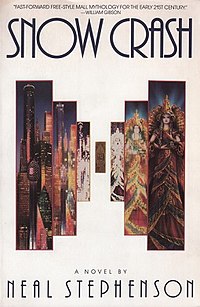
Snow Crash

Snow Crash, by Neal Stephenson, technically falls within the sub-genre of Cyberpunk. It contains the necessary elements: virtual reality hackers, a fascination with Japanese culture, a gritty dystopia. I feel a little uncomfortable putting Snow Crash in that box though. Snow Crash constantly subverts and toys with the rules and conventions of noir. For god's sake, the main character's name is Hiro Protagonist. Like Slaughterhouse Five, Snow Crash is bigger and better than any labels that could be attached to it. It may not be great literature, but it is a great read.


Perhaps the best way to describe Snow Crash is listing what the author prioritizes in writing it. Stephenson's first and foremost concern is humor. Snow Crash isn't quite out and out wacky like a Terry Pratchett novel, but it is basically hilarious. The next most important thing in Snow Crash is being cool. There is just a lot of badass stuff in the book, enough that the characters sometimes actually comment on it. Which leads us into the tertiary goal of Snow Crash: crazy bombastic action. Finally, surprisingly, Snow Crash is about fascinating hard science fiction with a core of thoughtfulness that serves as ballast, keeping the lighter parts of the book from drifting off into the realm of pure fluff.

The story revolves around Hiro Protagonist: hacker, swordmaster, pizza deliveryman. He is drawn into an ever expanding fight against a new drug called Snow Crash. He races through a fun setting where each suburb is its own little country; populated by rad skate punks, the Mafia, and cyborg doggies.  To go into more detail would spoil the enjoyment, so I'll leave it at that. I will note that the book came out in the early '90s and has a sort of undefinable '90s attitude to it. Snow Crash, like many sci-fi books, extrapolates a future out from it's own decade. So the obsessions of the 1991 are all touched on, the malls, the fresh 'tude, the burbs, etc (think the movie Clueless). What can I say, it was an innocent time.

Snow Crash is kinda like this!

If it wasn't clear from the review, I loved Snow Crash. The humor, the action, the science- it all worked for me. This is the part where I always quibble but I've got to say, I'm really scrounging here. Um, the end was kind of abrupt? The characters kind of rely on the reader to sketch in their personalities a bit, maybe? I don't know, it was great, everyone should read it. 14 out of 15 boats destroyed!


Sunday, June 2, 2013

Do Androids Dream of Electric Sheep?

Do Androids Dream of Electric Sheep?, by Philip K. Dick, is a fairly well known book. But that does not mean it is necessarily mean it is widely read.  I'm guessing a good portion of its fame comes from being the inspiration for the classic sci-fi movie Blade Runner.  While the book shares the main plot framework as Blade Runner, they are very different beasts. The movie is a melancholy cyberpunk thriller, the book... well Do Androids Dream of Electric Sheep? (DADES) is a violent acid trip bursting with strange ideas.


There is a dream like quality to DADES that caught me off guard. The whole book is like a vivid nightmare. There is an alienness to the post-apocalyptic setting and characters. Conversations veer off in totally unforeseen directions. Time and again the nature of reality is called into question. The facts never seem to quite add up, incongruities abound to trip up careful readers. It is all wholly engaging while simultaneously exhausting.

The story follows a bounty hunter, Deckard, on One Bad Day(TM). His job is to hunt down six advanced killer androids, recent escapees from Mars. These androids are virtually indistinguishable from normal humans- except that they lack empathy. What follows is a bizarre cat and mouse game, complete with a femme fatale, an extra-dimensional psychic entity, and a goat. Dick throws in a lot of  random world building stuff, all of which do relate to the central theme of human empathy. Some of it doesn't work, sometimes element of DADES don't quite mesh. But overall I was quite taken with the messy yet fascinating world of DADES.


Special note must be made of the stars of Do Androids Dream?: the androids themselves. Minor spoilers follow. The androids are basically humans without empathy and we have a word for humans lacking empathy: psychopaths.  The android characters attempt to blend in, but time and again their alienness shines through. It's hard to overstate how well they are written. The androids are at once repellent and terrifying, and simultaneously completely fascinating.  In Blade Runner, androids are noble escaped slaves, full of passion. I much prefer the androids of DADES; the frustrated, brutal, devious killing machines.

Do Androids Dream of Electric Sheep? is a fine book, one that fully deserves it's fame. It also will not work for some people. I can see the fever dream world in which it is set turning people off.  And as noted, DADES's more surreal elements don't always fit nicely. There are part of DADES written tightly as a drum, it draws attention then to certain slack scenes.  Those quibbles aside, this is a great book, one that rewards close attention and further thought.  Do Androids Dream of Electric Sheep? scores 9.2/10 on the Voight-Kampf test.

Monday, May 13, 2013

The Black Sun

The Black Sun by Jack Williamson reads like a classic sci-fi story. It has the bland characters, stolid prose, plodding pace that are the hallmarks of the golden age of science fiction. The Black Sun was actually written in 1997 though. I think we can excuse the datedness of book since Jack Williamson is in fact one of those golden age writers. He's still going after seventy years of writing!  I was confused by the praise for The Black Sun inside the cover. But how could reviewers slam a Jack Williamson book? Jack Williamson created the term "genetic engineering"! What have you done with your life!? Nothing!


So anyways, The Black Sun is not very good. As I implied above, it's characters are simple constructs: generic good guys, cartoonish bad guys, adorable moppet children/creepy possessed children.  I'll give Williamson credit where its due, he creates tragic pseudo-literature style backstories for everyone. The problem is these poignant flashbacks are delivered in an artless expository style that failed to connect emotionally with me. One gets the sense that the author is really trying to create interesting complicated characters, but something tells me this isn't a Williamson strength. But The Black Sun's problems go beyond the flat characters.


The plot has issues too. The main one being that Black Sun's story is one that has been told many times in science fiction- and with more verve. Tell me if this sounds familiar: a group of space explorers, trapped on a mysterious dead alien world, within the cyclopean catacombs comes the stirrings of something deadly.  The most recent example of this story comes in the form of the movie Prometheus. As in Prometheus, sometimes the characters react in bewildering ways. Prometheus had a xenobiologist run away upon discovering a dead alien as opposed to wanting to study it. The brave space pioneers of The Black Sun immediately assume a rainbow beacon from aliens is some sort of warning and attempt to avoid contact at all costs (their idea of exploring alien ruins is to drive up to buildings and then freak out and run away like eight year olds daring each other to go into an abandoned house).

The setting of The Black Sun.

So no, I cannot say I enjoyed The Black Sun too much. It has its moments, and towards the end it starts being straight up compelling. But it was too little, too late.  If you are a fan of golden age style sci-fi then The Black Sun may be for you. But for the rest, you guys can safely give this a miss. The Black Sun receives 4 out of 7 strange black beads.

------------

Spoilers for the end of the book follow.
The end of The Black Sun presents an interesting scenario. The surviving colonists form a sort of alliance with the psychic spirits that haunt the planet. The author presents this partnership as a happy ending. But it is in no way an equal relationship. The alien spirits seem to feel free to possess humans whenever they like. The spirits don't tend to have much regard for their host bodies either. An alternate reading of the ending, one that goes against the authors intent I'm sure, is that colonists are/will be slaves of the alien spirits- convenient bodies for them to inhabit. There are some details in the text to support this reading as well.

Excession

I thoroughly enjoyed Iain Banks novel, Excession.  It's packed with fun, interesting ideas and theories.  The characters are all weirdoes, and the plot is unpredictable. On the flipside, Excession isn't for everyone. It is a meandering book more interested in world building than any action. So, a dilemma. I think the best solution is to describe the book, its strengths and weaknesses, and let you, the reader, decide it's overall merit.


Excession is part of a loose "series" called The Culture. It is not so much a series as a setpiece- the only thing Culture novels have in common with each other is the setting. I didn't have any problem with Excession as a standalone book. I should note though that I had skimmed the Wikipedia entry on the The Culture before hand, so I had at least some familiarity with the setting. Excession is very much a book about the galaxy bestriding civilization called The Culture. To such a degree that ones enjoyment of the book is directly linked to ones enjoyment of The Culture. So what is The Culture?

Essentially, The Culture is the Federation from Star Trek. Simple as that really. They have similar levels of technology- transporters, replicators, forcefields. Both the Federation and the Culture are post-scarcity multi-species utopias (so no money, no real property ownership, society bound together more by empathy than physically enforced laws).  As utopias, each civilizations' overall striving are now directed outwards; having solved all their internal problems, they seek to solve the problems of other civilizations.  Star Trek's Federation places a greater emphasis on exploration, the Culture places the emphasis of its expansion on fostering progress and enlightenment. Both civilizations pride themselves on having the moral high ground.

Blood brother to Excession?

So how can Excession be about an entire civilization? Two ways. First is that the titular Excession is one of those classic sci-fi 'mysterious alien artifacts of immense, but unknown power.' It's discovery sparks off a Culture wide crisis. So the main plot is about how the Culture reacts to an unprecedented danger/opportunity. Basically, shaking the civilization and seeing what drops out of it. The book is a series of interwoven short stories from a multitude of perspectives- each at least tangently related to the main plot.  The characters in the Excession are meant to represent the Culture as a whole- there is a broad variety of them each illustrating a different facet of the Culture. In this way Excession manages to portray the overall civilization.

I loved this stuff. The writing was smooth, the book moves along at a steady clip. And the world of Excession is just a lot of fun. It didn't bother me that Excession is also incredibly dense, loosely plotted, with many a one-note character. Who cares if a character is cartoonish, if that character is a conspicuously ghoulish vigilante who just so happens to be a sentient dream-stealing spaceship?  That is awesome.  Actually, there is plenty of humor in the book (I particularly liked the names of the Culture warships).  I heartily recommend Excession, unless all the stuff I described in my review seemed lame to you in which case I don't recommend it.  8 out of 11 stars or 4 out of 9, if you don't think it sounds good!

Sunday, April 21, 2013

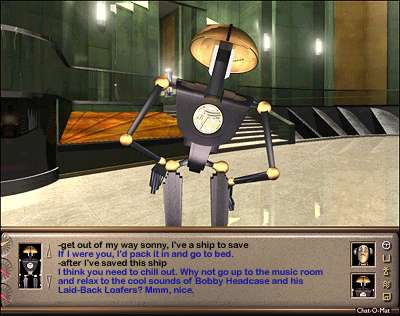
Starship Titanic


Starship Titanic is a sci-fi comedy written by Douglas Adams (of the Hitchhiker's Guide to the Galaxy) and Terry Jones (of Monty Python). That is some fucking pedigree right there. Starship Titanic is also an adventure video game.  In fact, the book itself is merely an adaption based on the game, something of a rarity before 2007.  All books that are adaptions of video games or movies are kinda crappy- it is an immutable law of the universe.  For an example, feel free to check out my review of Halo Cryptum. Accordingly, the best Starship Titanic could hope to be is pleasantly readable.

Starship Titanic is a pleasant read.

It has some chuckles, but the the book is willfully slight. Even for a humor book, Starship Titanic is light on conflict, compelling characters, ideas.  At a little more than two hundred pages (with big font) Titanic wasn't written with big ambitions in mind. But for what it is, it is fun.  The pages slip by at a good clip, although the plot is weirdly lumpy. The characters, of whom there are quite a few, each have their own personal character arcs, a nice touch. The video game scaffold of the whole thing only rarely shows- mostly in various item collection subplots.

From the game.

Because of the insubstantialness of Starship Titanic, I struggle to find more words to describe it. If you are looking for a little more Douglas Adams style comedy, pick it up. It doesn't take too long to read after all. But Starship Titanic is by no means an essential. For that reason, it only recieves 5/7 cerebral arteries.