Monday, May 13, 2013

The Black Sun

The Black Sun by Jack Williamson reads like a classic sci-fi story. It has the bland characters, stolid prose, plodding pace that are the hallmarks of the golden age of science fiction. The Black Sun was actually written in 1997 though. I think we can excuse the datedness of book since Jack Williamson is in fact one of those golden age writers. He's still going after seventy years of writing!  I was confused by the praise for The Black Sun inside the cover. But how could reviewers slam a Jack Williamson book? Jack Williamson created the term "genetic engineering"! What have you done with your life!? Nothing!


So anyways, The Black Sun is not very good. As I implied above, it's characters are simple constructs: generic good guys, cartoonish bad guys, adorable moppet children/creepy possessed children.  I'll give Williamson credit where its due, he creates tragic pseudo-literature style backstories for everyone. The problem is these poignant flashbacks are delivered in an artless expository style that failed to connect emotionally with me. One gets the sense that the author is really trying to create interesting complicated characters, but something tells me this isn't a Williamson strength. But The Black Sun's problems go beyond the flat characters.


The plot has issues too. The main one being that Black Sun's story is one that has been told many times in science fiction- and with more verve. Tell me if this sounds familiar: a group of space explorers, trapped on a mysterious dead alien world, within the cyclopean catacombs comes the stirrings of something deadly.  The most recent example of this story comes in the form of the movie Prometheus. As in Prometheus, sometimes the characters react in bewildering ways. Prometheus had a xenobiologist run away upon discovering a dead alien as opposed to wanting to study it. The brave space pioneers of The Black Sun immediately assume a rainbow beacon from aliens is some sort of warning and attempt to avoid contact at all costs (their idea of exploring alien ruins is to drive up to buildings and then freak out and run away like eight year olds daring each other to go into an abandoned house).

The setting of The Black Sun.

So no, I cannot say I enjoyed The Black Sun too much. It has its moments, and towards the end it starts being straight up compelling. But it was too little, too late.  If you are a fan of golden age style sci-fi then The Black Sun may be for you. But for the rest, you guys can safely give this a miss. The Black Sun receives 4 out of 7 strange black beads.

------------

Spoilers for the end of the book follow.
The end of The Black Sun presents an interesting scenario. The surviving colonists form a sort of alliance with the psychic spirits that haunt the planet. The author presents this partnership as a happy ending. But it is in no way an equal relationship. The alien spirits seem to feel free to possess humans whenever they like. The spirits don't tend to have much regard for their host bodies either. An alternate reading of the ending, one that goes against the authors intent I'm sure, is that colonists are/will be slaves of the alien spirits- convenient bodies for them to inhabit. There are some details in the text to support this reading as well.

Excession

I thoroughly enjoyed Iain Banks novel, Excession.  It's packed with fun, interesting ideas and theories.  The characters are all weirdoes, and the plot is unpredictable. On the flipside, Excession isn't for everyone. It is a meandering book more interested in world building than any action. So, a dilemma. I think the best solution is to describe the book, its strengths and weaknesses, and let you, the reader, decide it's overall merit.


Excession is part of a loose "series" called The Culture. It is not so much a series as a setpiece- the only thing Culture novels have in common with each other is the setting. I didn't have any problem with Excession as a standalone book. I should note though that I had skimmed the Wikipedia entry on the The Culture before hand, so I had at least some familiarity with the setting. Excession is very much a book about the galaxy bestriding civilization called The Culture. To such a degree that ones enjoyment of the book is directly linked to ones enjoyment of The Culture. So what is The Culture?

Essentially, The Culture is the Federation from Star Trek. Simple as that really. They have similar levels of technology- transporters, replicators, forcefields. Both the Federation and the Culture are post-scarcity multi-species utopias (so no money, no real property ownership, society bound together more by empathy than physically enforced laws).  As utopias, each civilizations' overall striving are now directed outwards; having solved all their internal problems, they seek to solve the problems of other civilizations.  Star Trek's Federation places a greater emphasis on exploration, the Culture places the emphasis of its expansion on fostering progress and enlightenment. Both civilizations pride themselves on having the moral high ground.

Blood brother to Excession?

So how can Excession be about an entire civilization? Two ways. First is that the titular Excession is one of those classic sci-fi 'mysterious alien artifacts of immense, but unknown power.' It's discovery sparks off a Culture wide crisis. So the main plot is about how the Culture reacts to an unprecedented danger/opportunity. Basically, shaking the civilization and seeing what drops out of it. The book is a series of interwoven short stories from a multitude of perspectives- each at least tangently related to the main plot.  The characters in the Excession are meant to represent the Culture as a whole- there is a broad variety of them each illustrating a different facet of the Culture. In this way Excession manages to portray the overall civilization.

I loved this stuff. The writing was smooth, the book moves along at a steady clip. And the world of Excession is just a lot of fun. It didn't bother me that Excession is also incredibly dense, loosely plotted, with many a one-note character. Who cares if a character is cartoonish, if that character is a conspicuously ghoulish vigilante who just so happens to be a sentient dream-stealing spaceship?  That is awesome.  Actually, there is plenty of humor in the book (I particularly liked the names of the Culture warships).  I heartily recommend Excession, unless all the stuff I described in my review seemed lame to you in which case I don't recommend it.  8 out of 11 stars or 4 out of 9, if you don't think it sounds good!

Sunday, April 21, 2013

Starship Titanic


Starship Titanic is a sci-fi comedy written by Douglas Adams (of the Hitchhiker's Guide to the Galaxy) and Terry Jones (of Monty Python). That is some fucking pedigree right there. Starship Titanic is also an adventure video game.  In fact, the book itself is merely an adaption based on the game, something of a rarity before 2007.  All books that are adaptions of video games or movies are kinda crappy- it is an immutable law of the universe.  For an example, feel free to check out my review of Halo Cryptum. Accordingly, the best Starship Titanic could hope to be is pleasantly readable.

Starship Titanic is a pleasant read.

It has some chuckles, but the the book is willfully slight. Even for a humor book, Starship Titanic is light on conflict, compelling characters, ideas.  At a little more than two hundred pages (with big font) Titanic wasn't written with big ambitions in mind. But for what it is, it is fun.  The pages slip by at a good clip, although the plot is weirdly lumpy. The characters, of whom there are quite a few, each have their own personal character arcs, a nice touch. The video game scaffold of the whole thing only rarely shows- mostly in various item collection subplots.

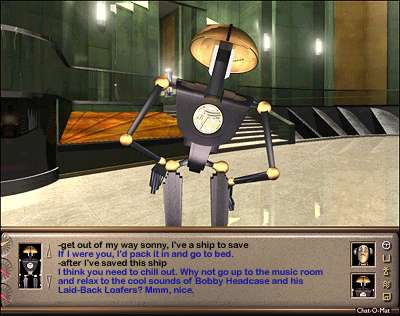
From the game.

Because of the insubstantialness of Starship Titanic, I struggle to find more words to describe it. If you are looking for a little more Douglas Adams style comedy, pick it up. It doesn't take too long to read after all. But Starship Titanic is by no means an essential. For that reason, it only recieves 5/7 cerebral arteries.

Sunday, April 7, 2013

A Small and Remarkable Life

A Small and Remarkable Life, by Nick DiChario, is an interesting book.  It is a science fiction novel in the style of the movies E.T. or Batteries Not Included. You know, the type of deal where a charming/cute naive little alien teaches us all a lesson in life, laughter, and caring. On a side note, I find it weird that there is this entire sub-genre of life-affirming-cute-aliens stories. Why not life affirming manatee-men? Or maybe tiny rapping dinosaurs that wear cool shades?


ANYWAYS, A Small and Remarkable Life is in fact a twist on this type of story. The book is set in the mid-1800s, in an America that has yet to be domesticated, civilized. Although much of the book takes place in upstate New York this is not a gentle pastoral tale. It is a bloody story, filled with hard men, frontier justice, and mercy killings. As one can imagine, the collision between the brutal setting and the lovable little magic alien makes for an interesting conflict.

And a A Small and Remarkable Life succeeds. For what it is worth, the book is positively packed with both ignorant people living hardscrabble lives and a little guy who can heal both bodies... and souls.  I'm just not sure the conflict of tone is enough to sustain the whole book. While the setting and writing shines, the plot feels slack, empty in a way. The alien, Tink, is born, has a ton of traumatic encounters, dies. Tink forges no great friendships with anyone. And while he ends up helping some people, most of the inspiring stuff happens "off screen."  There are themes: the nature of the soul, the nature of mercy, etc. there isn't any real message, just sort of a muddying up of philosophical waters.

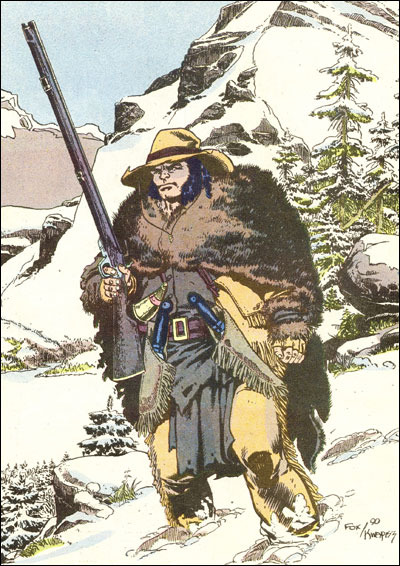
Wolverine of the X-men makes a guest appearance in the book.


Despite its short comings A Small and Remarkable Life is worth a read. Its short enough that you could read it in one sitting, even if you don't find it quite to your taste, as I did. And the prose is clear, the atomsphere is strong, the characters are multi-faceted. Its hard to argue with that. A Small and Remarkable Life recieves 2 out of 3 prize jams.

Disclaimer: Wolverine isn't in A Small Remarkable Life. That was a lie.

Monday, March 18, 2013

Lord Valentine's Castle

Lord Valentine's Castle, by Robert Silverberg, is a fluffy book. You can tell just by judging it's cover. There is a handsome man wearing tights and a half-cape juggling. Some doofy looking aliens are hanging out in the background. Throw the fruity title into the mix and... well the book isn't a journey into the dark heart of humanity, lets just say.

Just look at that goofy son of a bitch!


But you know what? That's fine. Silverberg no doubt set out to make a light adventure novel, and he succeeded.  Because the world needs light frilly fantasy. Hell, I need a frilly fantasy, from time to time. This past month is one of those times. Those of you who have been following the blog may have noticed I've been reading weird slog after weird slog.  Lets just say I needed to read a book that actually had a concrete plot and relatable characters. 

Lord Valentine's Castle follows the adventures of the amnesiac wanderer, Valentine. It quickly becomes apparent that there is more to Valentine than there seems; and to the credit of the author there is no attempt to make the 'twist' of the first part of the book seem shocking. No, in Lord Valentine's Castle the emphasis is always on the journey. The plot is almost shockingly straight forward. The details and thoughtfulness is instead lavished on the setting. Descriptions of mighty cities, of strange forests, and bizarre creatures fill the book. The mechanics of the world of Majipoor are gently explored in interesting exposition asides. Majipoor is a paradise world full of wonders big and small (mostly big though).

This is unrelated to Lord Valentine's Castle.


The downside to this world building is twofold. First, the plot could have used a little bit more spice. Valentine decides on a straight forward plan of action and it goes off without a single hitch, exactly as it was expected to. Second, the characters are on the anemic side, dwarfed by the size of the world and their monumental task. Which was frustrating, since each character introduced has some fascinating hook to their person that hints at greater plot/character potential. 

Lord Valentine's Castle is a smooth, compulsive read. For a book so full of exposition it only rarely drags. But it is also a big book and by the end the hollowness of Valentine's Castle began to gnaw at me.  There is no great ethical dilemmas, no heated character moments, none of the tension of greater literature. No humor, no cleverness, no message. But Lord Valentine's Castle does have inspiring imagination and the promise of endless new adventure around every corner. Which makes for a pretty good time!

Lord Valentine's Castle receives 39 of the 50 cities of Castle Mount.

Wednesday, February 6, 2013

Analogue: A Hate Story

You are a deep space explorer. You have been hired by a Historical Society to investigate a recently discovered derelict space craft. It is an ancient colony ship from the pre-FTL (faster than light) days. Uncover the final fate of a bizarre lost society.

Analogue: A Hate Story, by Christine Love, is not a standard book. It isn't a book at all in fact. It is whats known as IF, Interactive Fiction. Interactive Fiction is exactly what it sounds like: they are stories you interact with, generally through text commands. The player/reader has some amount of control over the story. If Analogue is a video game then why am I reviewing it? Well I feel like it mostly meets the criteria for a short story. This is a "game" in which your primary action is to read old diary entries. While the player/reader has some input in the game Analogue is mostly a linear experience. What I'm saying is that Analogue is practically short story- just instead of turning pages you navigate computer menus.


Analogue is, at its core, a detective story. The reader is the investigator. You slowly but surely unravel a brutal tale, told in snippets and rumor. The ship's AIs are your companions and helpers in this task. I should note that AIs in Analogue are fully sentient and have their own personalities. Hyun-ae, the ship AI, is a sweety. She is a particularly well drawn character. Mute is a bit trickier to describe but also interesting. The diary entries you pour over have their own sets of interesting characters. Reading through the private dreams and desires of the colony ruling class really makes life onboard the ship come to life. Obviously, there is a limit to what I can say without spoiling the story. Suffice to say it is both powerful and dramatic, providing the reader with moments of pure enjoyment. By relying on player agency, the reader really becomes drawn into the unfolding story.

I do have some quibbles with Analogue, of course. The setting, a massive dark tomb-ship is underused. Since the entire game takes place on a computer screen it can be easy to forget what the setting is. Never seeing (in either still image or even textual description) the setting blunts the dramatic impact of the mystery.  Also, the story takes awhile to pick up steam and momentum can occasionally be killed if you are stumped on something.

In conclusion, Analogue is a good read and an interesting experience. I recommend it to anyone adventurous enough to step out of their comfort zone. Don't be scared off by the anime style. While the author is a obviously a fan of anime, Analogue is an accessible story; and the juvenile tendencies of anime don't crop up. Analogue receives 78/100 journal entries. You can find it here.

Sunday, February 3, 2013

The Sky Lords


Oh, The Sky Lords. You are a silly silly book. Not on purpose mind you. Indeed, The Sky Lords takes itself very seriously.  But all the same it is jam packed with fun concepts like talking panthers, post-apocalyptic amazonian societies, and insane killer cyborgs.  With all that and more, of course I enjoyed reading The Sky Lords.  But I would caution that it is not some sort of hidden gem. It's a dour and flat read.

The Sky Lords is set in a post-apocalyptic world in which genetic engineering run amok has all but ended human civilization. Most of the wilderness has been lost to a fungal blight and insane monsters created by science run amok. Those civilizations that remain follow the standard for post-apocalyptic societies- regressed to a brutal medieval level with only a few pieces of technology still understood and maintained.  One by one towns succumb to plague or genetically engineered monsters or warfare. While ground based towns have no way of attacking one another there are marauding zeppelin cities (the titular Sky Lords) that sustain themselves off tribute from the ground dwellers. As you can tell from my description it is jam packed setting. (Although it bears quite a few similarities to the anime Nausicaa of the Valley of the Wind.)

A Korean trailer for you!

The plot follows the trials and travails of Jan, last of the Amazons. Yeah, this book is cheesy as hell like that. I want to avoid spoilers so I'll avoid getting into details. Suffice to say, Jan spends most of the book simply trying to make the best out of a series of bad situations.  Despite the occasional time jump, the plot is very linear. It follows the pattern of "this happened, then this happened, then this happened." The Sky Lords isn't badly written but there is an artlessness to the prose that makes the whole thing feel rather flat. The book does pick up at times. The only other character of note in the whole book is a mysterious man named Milo. Milo is a complicated, interesting character and the book's best moments generally center around him.

Ultimately, I feel a little frustrated by The Sky Lords. It had the potential to be a really fun book. I mean, the setting alone is golden. But plot is unrelentingly grim and methodical. Although it sounds sappy, I think what The Sky Lords is missing is heart. It is full of toys but refuses to play around. For that reason I reluctantly give The Sky Lords 6.7 out of 10 samurais on gliders.